Hip Circles (prone)
The Hip Circles (prone) isolates the Abductors through a controlled range of motion. This beginner-level body only exercise builds focused strength where compound movements often fall short.
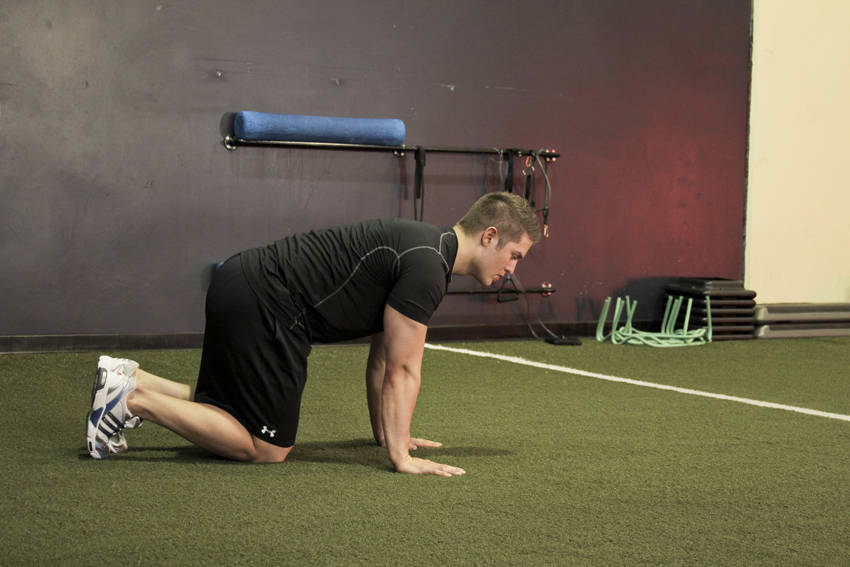
Starting position
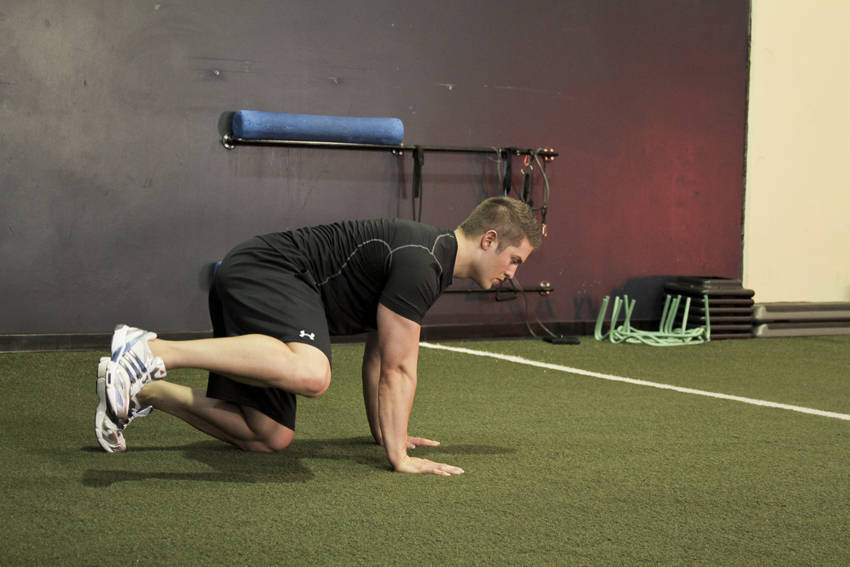
Ending position
Muscles Worked
The abductors handles the primary load during this movement. The adductors assist as stabilizers throughout the range of motion.
How to Hip Circles (prone)
- 1
Position yourself on your hands and knees on the ground. Maintaining good posture, raise one bent knee off of the ground. This will be your starting position.
- 2
Keeping the knee in a bent position, rotate the femur in an arc, attempting to make a big circle with your knee.
- 3
Perform this slowly for a number of repetitions, and repeat on the other side.
Common Mistakes
- • Focus on the mind-muscle connection — feel the target muscle working through each rep.
- • Use a controlled tempo of 2 seconds up, 2 seconds down to eliminate momentum.
- • If reps become too easy, slow the tempo or add a pause at the hardest point rather than rushing through more reps.
- • Squeeze at peak contraction for a full second — this is where most of the growth stimulus occurs.
Similar Exercises
Frequently Asked Questions
What muscles does the Hip Circles (prone) work?
The Hip Circles (prone) primarily works the Abductors. Secondary muscles include the Adductors, which assist during the movement.
Is the Hip Circles (prone) good for beginners?
Yes, the Hip Circles (prone) is suitable for beginners. Start with light weight to master the 3-step form before adding load.
What equipment do I need for the Hip Circles (prone)?
You need no equipment — just your bodyweight to perform the Hip Circles (prone). This makes it ideal for home workouts.
Track Your Progress
RepStack logs every set, calculates your e1RM, and coaches progressive overload — automatically.